The guide was compiled by our experts Toomas Prangli, Kaupo Lepasepp, Robin Teever, Eva Lennuk and Kevin Piho. Alternatively, you can find the guide in PDF format here.
1. How to prepare
1.1. Mapping of operations
Prior to incorporation, it is strongly advisable to map out the company’s core operations. This helps clarify what legal and structural elements are needed for setting up in Estonia and supports the creation of a clear organisational structure.
In practice, early-stage investors, advisors and banks generally expect certain key information to be prepared in advance. This includes a pitch deck, founders’ CVs, corporate structure and preliminary cap table. A profit and loss statement or forecast is also important, together with any evidence of early client traction (if relevant), such as letters of intent, memorandums of understanding or other existing contractual relationships.
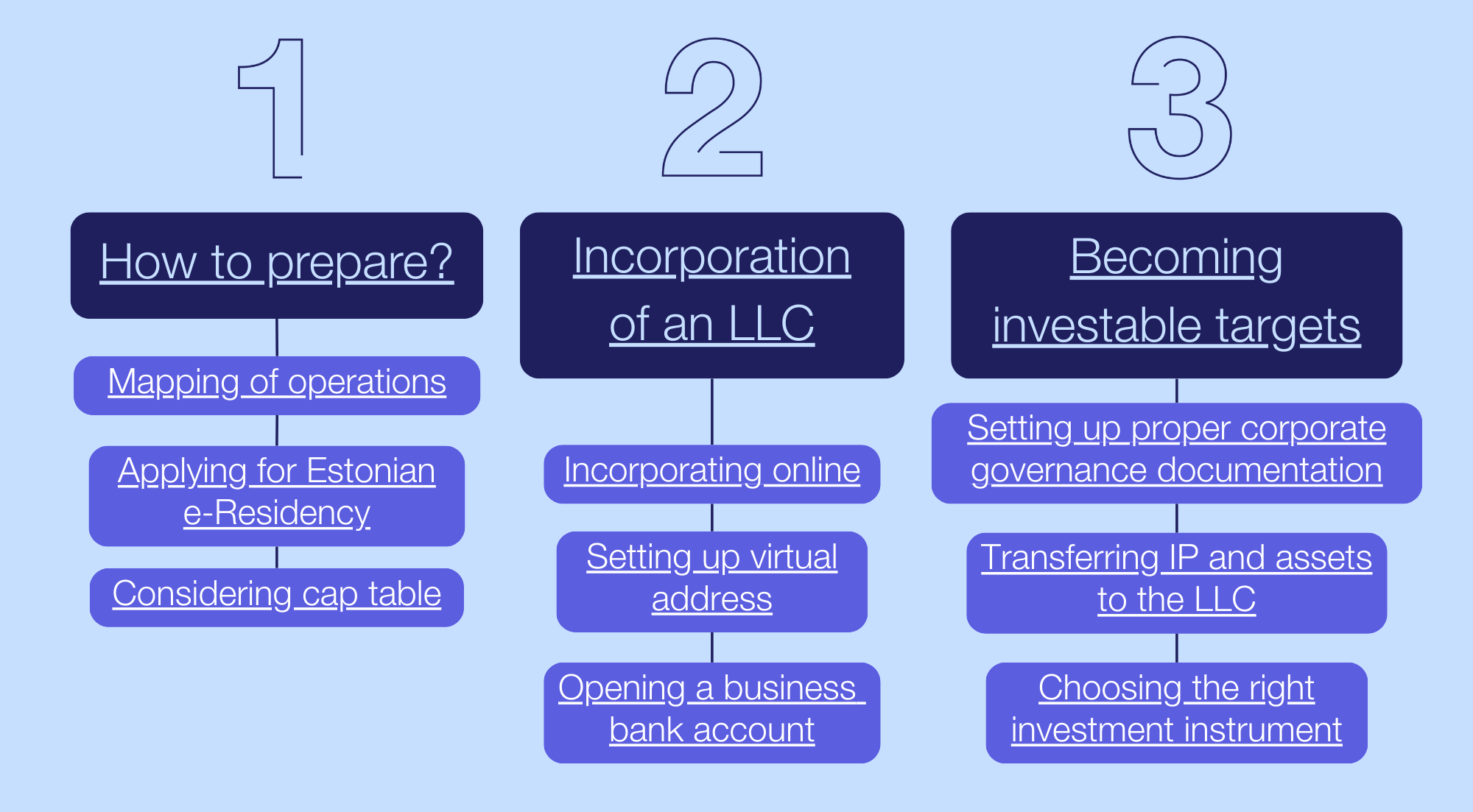
1.2. Estonian e-Residency
Estonian e-Residency is a government-issued digital identity that serves as the cornerstone for accessing Estonia’s e-services in general, and establishing and managing a company in Estonia in particular. To apply, you just need to access the official e-Residency website (https://www.e-resident.gov.ee/), fill out the application form, and pay the state fee (EUR 150). Once approved, you will receive your e-Residency card, which grants you access to Estonia’s digital business environment. You can select one of over 50 official pickup locations worldwide, including the Estonian embassy in Kyiv.
1.3. Preliminary cap table division
Carefully weigh up the initial cap table division and consider the desired division of ownership between founders, employees and advisors (the option pool), and the portion that will be allocated to investors. Although the legal minimum share capital in Estonia is just 1 euro cent, it is advisable to set a higher amount – typically in the range of EUR 1,000 to 10,000 – to allow for more accurate dilution calculations in relation to future investments. This also provides a more realistic foundation for equity distribution among founders, and (potential) option holders.
A distinctive feature of Estonian private limited liability companies (LLCs) is that they do not issue multiple “shares” in the traditional sense to investors. Instead, each shareholder holds a single share of the class with varying nominal values. For practical purposes, the “shares” often refer to the 1 euro cent notional part of the shareholding. For example, when “100 shares” are referenced, this usually means one share with a nominal value of EUR 1.
If the share capital is at least EUR 10,000, the company can waive the notarisation requirement for future share transfers. This can simplify and reduce the cost of equity transactions down the line (e.g. transfers to founders’ holding companies or investors’ affiliates, secondary transactions).
1.4. Marital status of founders
Consider how the founders’ marital status may affect their role as shareholders. Marital property laws may mean that shares have to be owned jointly. Ensure that any necessary agreements or arrangements are made to address this issue to avoid any misunderstandings later on.
2. Incorporation of an LLC, (osaühing in Estonian)
2.1. Incorporation online
Incorporating an LLC in Estonia is a straightforward process for e-residents, who can complete the process online and as rapidly as within a single business day. Establishment costs are relatively low.
2.2. Virtual address
As part of the Estonian company incorporation process, a local business address is required. We recommend reaching out directly to virtual address service providers, many of whom also offer integrated accounting and payroll systems, which enables consolidating these essential services under one roof.
2.3. Opening a business bank account
Proof of a bank account is not needed for incorporation; however, for operational purposes, it is important to have one. Opening an account at a bank may take some time due to KYC procedures. For a quick and convenient start, we recommend using an online payment platform, which are easy to set up and should satisfy most of the LLC’s banking needs in the early stages. Note that many online platforms do not onboard defence sector clients, so do be sure to consult with your advisors about the relevant guidelines.
Opening an account with a traditional Estonian bank is more complex without a local presence and may require more business substance in Estonia than merely incorporation. Before starting the process, it is advisable to enquire which banks are the most comfortable with the defence sector.
3. How to become investable targets
3.1. Proper corporate governance documentation setup
Estonian LLCs operate under a flexible two-tier system, consisting of shareholders and a management board, which serves as the executive body. Not all founders need to be on the management board – shareholders retain sufficient oversight and control.
Establishing strong governance from the outset is key to building investor confidence. This includes concluding a founders’ agreement (i.e. a simplified form of a shareholders’ agreement) that clearly outlines the roles, responsibilities, equity ownership, decision-making processes, and exit strategies among founders.
One of the most important elements to include is an agreement on reverse-vesting: if a founder leaves early, unvested shares can be reclaimed by the LLC or other founders. This protects the team and future investors from inactive or departing co-founders retaining significant equity if they are no longer contributing to the LLC’s growth.
3.2. IP and asset transfers to the LLC
Once the LLC is up and running, all intellectual property (IP) and relevant foreign assets (such as your Ukrainian company) that are legally permitted to be transferred can be consolidated under or transferred to the LLC. This centralises ownership, simplifies governance, and enhances the LLC’s investment-readiness. While the full acquisition of all IP by the LLC may not be possible without the relevant export license, it is important to ensure that proper IP assignment agreements (with founders, employees and contractors) are in place at least at the Ukrainian company level.
We strongly recommend involving legal counsel in developing a comprehensive IP strategy (such as determining which assets can be transferred to the LLC) and ensuring that all cross-border legal, tax and regulatory (export control) considerations are properly addressed.
3.3. Choosing the right investment instrument
When preparing for your first external funding round, it’s important to choose the right investment structure. The usual options include a convertible loan agreement (CLA), a SAFE (Simple Agreement for Future Equity), or a direct equity investment. CLAs are widely used in Estonia and offer flexibility, converting into equity under predefined conditions while typically including interest and a maturity date. SAFEs – while simpler and more founder-friendly, with no interest or maturity – are less common locally and may not be preferred by all investors.
Direct equity investments provide immediate clarity on ownership and valuation but require more legal work upfront. Founders should weigh the LLC’s development stage, investor expectations, and long-term cap table implications when deciding which instrument best aligns with their goals. Template documents for each of these instruments can be found at: https://startupestonia.ee/resources/model-documents/.
4. Why Estonia?
As a point of principle – and of special importance to Ukrainian defence tech companies – Estonia is one of the strongest global supporters of Ukraine. The two countries have an aligned view on the region’s geopolitical security. But there’s more:
1. Strong and loyal supporter of Ukraine
Estonia is one of the most loyal and proactive supporters of Ukraine in Europe, both politically and militarily, which ensures:
- a welcoming attitude to Ukrainian defence tech founders and investors in Estonia from both the private and public sectors
- political and diplomatic support to Ukrainian defence tech founders, where needed
- openness to test and onboard tech solutions by Estonian Defence Forces, especially when these have proven to be successful in Ukraine
- relative ease of getting to access decision-makers in a small and open society like Estonia
2. Digital-first business environment
Estonia is a global pioneer in digital governance. Through its e-Residency program, non-EU residents can:
- establish and manage an EU-based company 100% online
- sign documents digitally and access banking, payment and accounting services remotely
- operate with minimal bureaucracy and maximum efficiency
3. Startup ecosystem and government support
Estonia is home to a vibrant startup scene:
- high density of startups per capita (including unicorns like Bolt, Wise and Pipedrive)
- healthy collaborative ecosystem, even among competitors
- efficient company law and corporate governance rules recognised as ensuring low levels of corruption
- government-backed initiatives like grants and programmes, such as Startup Estonia, which provides, inter alia, free standardised model legal documents developed in collaboration with the top law firms in Estonia, promoting best-practice governance and fundraising
4. Gateway to international markets
By incorporating in Estonia, your startup gains:
- access to the EU single market with the ability to passport services across the EU with fewer regulatory hurdles
- recognition among VCs and angel investors looking for EU exposure
- enhanced credibility and trust with EU partners and investors
5. Favourable tax system
Estonia offers one of the most startup-friendly tax regimes in the world:
- 0% corporate income tax on retained and reinvested profits
- tax is only paid when profits are distributed (e.g., as dividends)
- transparent and simple tax rules, ideal for holding structures
6. Special immigration tools for the startup sector
Relocating non-EU startup founders and tech employees to Estonia and employing them in the country is relatively streamlined thanks to Estonia’s progressive visa schemes and startup-friendly policies:
- non-EU founders can apply for a Startup Visa and bring their family members along
- if the startup has operated for more than 10 years, the Scale-up Visa may be used
- exceptions to general immigration quotas for ICT specialists, as well as for qualifying startups and growth companies