By 7 June 2026, EU Member States (including Lithuania) will be required to implement the EU Pay Transparency Directive (the Directive) through national legislation.
Although the Directive aims to establish pay transparency mechanisms to ensure that men and women are paid equally for equal work or work of equal value, in practice, its impact is likely to be broader. The Directive will increase the amount of information on pay available to employees, and employees will have far greater opportunities to raise issues (including initiating labour disputes) relating to remuneration, not necessarily limited to potential pay differences between men and women.
In Lithuania, the implementation of the Directive is already in progress, and it is planned that the new requirements for employers will become mandatory on 6 June 2026.
On 18 March 2026, the Government of the Republic of Lithuania approved draft legislation implementing the Directive, which will now be debated and adopted by the Parliament. Below, we provide information on the new regulations set out in these draft laws. Although there may still be some changes to them, preparations for implementing the Directive can now begin.
Most of the new requirements apply to every employer with staff in Lithuania, regardless of the number of employees.

1. Classification of jobs into categories
Based on objective, gender-neutral criteria, every employer will be required to classify the jobs within their organisation into separate job categories.
The subsequent provision of pay data and the assessment of potential pay gaps will be carried out with reference to these job categories, so this preparatory step is particularly important.
The Labour Code sets out the following mandatory criteria to be followed when evaluating and classifying jobs into categories:
- Skills, including ‘soft’ skills (i.e. those related to communication, collaboration, conflict resolution, the ability to work with others, and those relevant to performing a specific job function);
- Qualifications;
- Effort (i.e. the amount of physical, mental and emotional resources required to perform the tasks assigned to a specific role);
- Responsibility;
- Working conditions (i.e. the working environment, workload, risks, and physical and psychological factors).
In addition to the mandatory criteria listed above, employers may (and should) use other criteria, but these must be objective and gender-neutral.
Once the job evaluation has been carried out in accordance with the mandatory and additional criteria, jobs of the same or equivalent value must be assigned to the same job category (even if the job titles or the duties performed differ).
2. Remuneration system
From now on, every employer must have a remuneration system (policy), regardless of the number of employees. Significant changes are also planned in cases where remuneration is determined by collective bargaining agreements.
Mandatory remuneration systems. All employers, regardless of the number of employees, will be required to adopt a remuneration system. Currently, this is only mandatory for companies with 20 or more employees. The remuneration system must be drawn up in writing and made available to all employees.
Requirements for the content of the remuneration system. The remuneration system must include the following information:
- Classification of jobs into categories (i.e., which jobs are assigned to the relevant job categories);
- Forms of remuneration by job category or specific job;
- Pay ranges (i.e., from minimum to maximum) or specific amounts by job category or specific job;
- Information on additional remuneration (allowances, bonuses, various supplements and other variable pay), i.e. the grounds for awarding additional remuneration, amounts and payment procedures;
- Wage indexation (if applied in the company);
- Criteria and procedures for pay increase, if the employer has 50 or more employees.
Involvement of employee representatives. Before approving a new remuneration system or amending an existing one, employers must carry out information and consultation procedures with employee representatives (usually the Works Council, less commonly a trade union).
Establishment of a remuneration system in collective bargaining agreements. Where a remuneration system is established in a collective bargaining agreement, it automatically applies to all employees of the company (i.e. even if they are not members of a trade union and other parts of the collective agreement do not apply to them). This extended application of collective agreement provisions will apply to collective agreements adopted or amended on or after 7 June 2026.
3. Submission of pay data to state institutions
All employers (regardless of the number of employees) will be required to submit information to the State Social Insurance Fund Board (Sodra) on a monthly basis regarding their employees’ pay, working hours and job categories. This data will subsequently be used to prepare gender pay gap reports.
Submission of data to state institutions. Every employer will be required to submit information to Sodra on a monthly basis regarding employees’ working hours and pay. This will be in addition to the currently submitted SAM reports, which declare the pay calculated for employees and social insurance contributions.
The following information about each employee will be provided to Sodra:
- Remuneration;
- Working hours;
- Job category according to the company’s remuneration system.
Sodra will provide this data to the State Labour Inspectorate and the Office of the Equal Opportunities Ombudsman.
Procedures are currently being drawn up to regulate the provision of data to Sodra. Draft legislation provides that these procedures will be approved by 6 June 2026.
Pay data compiled by Sodra. Upon receiving the above-mentioned pay data from employers, Sodra will calculate and provide the following information to all employers:
a) On a monthly basis:
- The average monthly hourly pay for each employee;
- The average monthly hourly pay of all the company’s employees by gender in each job category
b) Annually:
- Each employee’s annual and average annual hourly pay;
- The average annual and average annual hourly pay of all company employees by gender in each job category.
Public disclosure of average pay data. Sodra will publicly disclose the average hourly pay by gender for employers with at least 8 employees (of whom at least 4 are men and at least 4 are women).
Please note that different requirements apply to the reporting of pay data of employees working under temporary agency employment contracts.
4. Gender pay gap reports
For larger employers (i.e. those with at least 100 employees), Sodra will prepare detailed gender pay gap reports. This information will be compiled based on the data employers submit to Sodra on a monthly basis. Employers will be required to share this information with employee representatives and employees.
Detailed gender pay gap reports. Based on the monthly pay data submitted by employers (see Section 3), Sodra will calculate and prepare the following information for the previous calendar year:
- The overall gender pay gap;
- The gender pay gap, taking into account additional pay;
- The median pay gap between men and women;
- The median pay gap between men and women, taking into account additional pay;
- Proportion of men and women receiving additional pay;
- Proportion of men and women in each pay quartile;
- The gender pay gap based on base pay and additional pay by job category.
Sodra will prepare and submit this gender pay gap report, depending on the number of employees³.
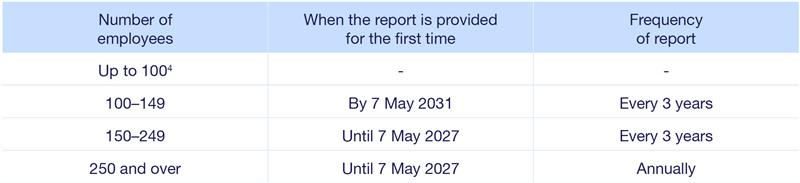
³ For the purposes of reporting, the number of employees is determined by the number of persons insured with ‘Sodra’ for a specific employer.
⁴The Labour Code provides for the possibility for employers with fewer than 100 employees to voluntarily participate in the preparation of gender pay gap reports (in such cases, the same deadlines apply as for companies with 100–149 employees).
Disclosing the gender pay gap information. Employers will be required to provide information prepared by Sodra on the gender pay gap by job category under the following conditions:
- The information is provided to employees and employee representatives (i.e. the works council, trade union);
- The information is provided within 1 month of receiving it from Sodra;
- This does not apply where there are fewer than 3 employees of the relevant gender in a specific job category.
Sodra will publish information on the gender pay gap on its website (excluding information on specific job categories).
Sodra will also submit this information to the State Labour Inspectorate and the Office of the Equal Opportunities Ombudsman.
Further explanations regarding the pay gap. If employees or their representatives have any queries regarding the information provided on the pay gap, they will have the right to request an explanation from the employer. In such cases, employers must provide an explanation no later than 1 month after receiving the request.
If the State Labour Inspectorate or the Office of the Equal Opportunities Ombudsman requests an explanation, the employer must provide it within 10 working days.
Please note that different requirements apply to the reporting of information on the gender pay gap for male and female employees working under temporary agency work employment contracts.
5. Differences in pay between men and women
If the gender pay gap report prepared by Sodra (see Section 4) reveals a difference of 5% or more between men’s and women’s pay in any job category, the Labour Code provides for additional measures that employers are obliged to take.
Unjustified gender pay gap. If the gender pay gap is not justified by objective, gender-neutral criteria, employers must rectify it within 6 months of receiving data from Sodra, in consultation with employee representatives.
Joint pay assessment. Employers will be required to carry out a joint pay assessment procedure if all of the following conditions are met:
- The information prepared by Sodra indicates a pay gap of 5% or more between men and women in at least one job category; and
- The employer has not justified this pay gap with objective and gender-neutral criteria; and
- The employer has not rectified the unjustified pay gap within 6 months of receiving the information.
The aim of the joint pay assessment is to identify and rectify unjustified pay gaps between men and women and to prevent them from arising in the future. This process must be carried out in consultation with employee representatives and subsequently presented to employees, their representatives and the State Labour Inspectorate.
The procedure and conditions for the joint pay assessment will be approved by secondary legislation, the drafts of which have not yet been published.
6. Employees’ right to information on pay
From 7 June 2026, employees will have the right to receive information on their own average pay and that of other employees in the same job category, broken down by gender. This right applies regardless of the number of employees in the company.
Employees’ right to receive pay information. Employees will have the right to receive written information from their employer regarding:
- Their annual pay;
- Their average monthly hourly pay;
- Their average annual hourly pay;
- Relevant data on the average pay of employees in the same job category, broken down by gender.
Employers will be required to inform employees at least once a year about their right to receive pay information and the procedure for exercising it.
Employers must provide written responses to employees’ requests for pay information within 1 month (or within 10 working days if the request is made through the relevant authorities). The information must be based on data prepared by Sodra and provided to the employer (see Section 3), but employers may also provide additional information or explanations.
Indirect request for pay information. Employees will have the right to request information on pay directly from the employer or to request this information indirectly, through:
- Employee representatives (e.g. a works council or trade union);
- The State Labour Inspectorate;
- The Office of the Equal Opportunities Ombudsman.
Protection of privacy. In the event that providing pay information of employees in the same job category could reveal the pay of another employee whose identity can be determined, this data will not be provided directly to the employee. In such cases, the employer will provide the requested information to:
- Employee representatives (e.g. a works council or trade union); or
- The State Labour Inspectorate; or
- The Office of the Equal Opportunities Ombudsman.
Once the aforementioned employee representatives or authorities have received the information from the employer, they will assess whether there is a pay gap of at least 5% between men and women within a specific employee’s job category. If such a difference exists, the employee will be informed of it (without disclosing the specific pay of their colleagues) and offered advice on further action (e.g., contacting the employer for clarification, seeking redress through the labour disputes commission, etc.).
Further explanations. If an employee considers that the information provided by the employer is insufficient or unclear, they will have the right to request further explanations, either directly or through employee representatives. Employers must provide additional explanations no later than 2 months from the date of the employee’s request for pay information.
Recommendations. To prepare for employees requesting pay information, we recommend establishing a clear procedure for how they can request it and how responses will be provided.
7. Changes to the regulation of pay confidentiality
From now on, employees will have the right to share information about their pay if this is done to ensure their right to equal pay for work of equal value.
Pay (non-)confidentiality. Amendments to the Labour Code stipulate that data on one’s own pay cannot be considered confidential information if an employee discloses it for the purpose of ensuring their right to equal pay for work of equal value.
However, employers will still be able to require employees to maintain the confidentiality of their pay in other situations, for example, by not making it public, not revealing it to competitors, not sharing information about other employees’ pay, and so on. We recommend updating confidentiality agreements accordingly and preparing communications for employees regarding pay confidentiality requirements.
8. Changes to the recruitment process
Employers will be prohibited from asking about a candidate’s pay history. The requirement for employers to specify the salary during the recruitment process remains in place.
Questions about pay. Employers are prohibited from asking job applicants about their current or previous pay.
Information in job advertisements. The requirement to disclose information about the offered salary or salary range in job advertisements remains in place. Where pay is determined by a collective bargaining agreement, employers must provide job applicants with the information governing pay as set out in that agreement.
9. Liability for breaches
In the event of a breach of the regulations on pay transparency, employers’ representatives will be subject to administrative liability (financial penalties). However, the greatest legal risk arises in cases of individual disputes with employees, as there are no longer any limits on the compensation that may be awarded for incompliance.
Claims by individual employees. With more information available about pay within the company, employees will consequently have greater opportunities and motivation to initiate legal disputes with their employer if they believe they may have been discriminated against in terms of pay.
If an employee were to win a dispute regarding the employer’s breach of the duty to pay equal pay for work of equal value, the employer may be ordered to pay:
- Unpaid wages, other payments or additional benefits in kind; and
- Compensation for loss of opportunity; and
- Moral damage; and
- Interest for late payment during the employment relationship; and
- If the employment relationship with the employee has already ended, the employee’s average wage from the date of employment termination until the decision of the labour dispute commission or the court is enforced. As the 6-month limit for this sanction will no longer apply, in certain cases, the risk to the employer may amount to the employee’s pay for a year or even longer.
Pay – not just the base salary. The definition of pay in discrimination disputes is much broader: it includes not only base salary, but also variable remuneration (bonuses, allowances, etc.) and any other remuneration (including remuneration in kind, e.g. benefits) that the employee receives directly or indirectly from the employer for their work.
Groups of companies. Disputes concerning pay discrimination will not be limited solely to cases where employees work for the same employer. In this context, employees performing work of equal value in other companies within the same group may also be considered, provided that pay or significant terms of pay are determined centrally within the group (i.e., there is a single source determining pay).
Administrative liability. The planned amendments to the Code of Administrative Offences provide for fines ranging from EUR 460 to EUR 6,000 for breaches of pay-related requirements, depending on the specific nature of the breach. As has been the case to date, such fines are imposed not on employers, but on company directors or other responsible persons.
Our employment law team is ready to help!
We advise on all matters relating to preparation for the implementation of the Directive, including:
- Assessing the classification of job categories and their compliance with legal requirements;
- Preparing or updating remuneration systems;
- Carrying out information and consultation procedures with employee representatives;
- Establishing procedures for providing employees with pay information;
- Updating confidentiality agreements and other documents relating to the confidentiality of pay;
- Training managers and other staff, etc.
As Sorainen is a fully integrated law firm operating in Lithuania, Latvia and Estonia, we are ready to assist with the implementation of the Directive across all Baltic countries.
Please contact our trusted experts: Agnietė Venckienė, Aurelija Daubaraitė, or Algirdas Pekšys.