Last November, Sorainen’s employment law team organised a webinar: Equal Pay – the New Directive and Legal Issues. While we await the first draft of the Latvian law, we have compiled the most frequently asked questions from clients during the webinar.
Which employers are covered by the directive?
The Directive applies to all employers. Furthermore, the remuneration of all employers’ workers must be based on the value of work. Subject to the number of employees, exceptions may be applied in the fulfilment of certain obligations laid down in the Directive (where Member States so provide in their national legislation), for example:
- Employers with up to 50 employees may be exempted from the obligation to notify employees of the criteria used to determine pay levels and pay developments;
- For employers with up to 100 employees, reporting the pay gap may not be mandatory.
Does the Equal Pay Directive only apply to equal pay for women and men, or does it introduce a broader approach to comparing the value of work and pay?
The principal objective of the Directive is to eliminate unequal pay in the labour market as a whole and to reduce the gender pay gap between women and men; however, the mechanism through which this objective is pursued is the ‘visibility’ or disclosure of pay differentials within each undertaking.
Employees will have the right to be informed of their individual pay level within the pay category to which they have been assigned by the employer. Separately, information must also be provided on pay levels broken down by gender.
Accordingly, the information mechanism established by the Directive essentially enables the comparison of remuneration not only between women and men, but also among employees in general (within the relevant employee category). Therefore, it cannot be maintained that pay differentials are assessed solely in the context of gender.
How is the employer identified? What happens in the case of a group of companies?
The Directive does not introduce a definition of ‘employer’; therefore, this notion should be interpreted in accordance with Article 4 of the Labour Law of Latvia, and the number of employees should be assessed at the level of the legal person (or partnership).
However, the “single source” exception may also apply, which may result in a comparison even between different employers. This provision was initially introduced in EU case law and has been taken over by the Directive.
The “single source” doctrine states that if pay conditions can be attributed to a single source (for example, a centralised pay policy within a conglomerate), then a comparison may also need to be made between employees working for different employers who are united by this policy.
What are the requirements for communicating with employees? What is the minimum information that must be provided, and to whom?
It is understandable that providing employees with more information will always raise additional questions. Employers must not only determine the value of work, but also should plan a communication strategy, as according to the Directive, all employers will have to provide employees (or their representatives) with written information on:
a) the individual pay level of the employee;
b) average pay levels by gender in the employee’s job category.
This information may be requested and obtained by employees themselves or by employee representatives. In addition, the right to receive this information must also be communicated annually.
If the information provided is incomplete, the employee or employee representatives may request clarification and more detailed information. Furthermore, the above information must be provided within two months of the date of the request.
At the same time, employers may restrict the further use of the information provided by imposing confidentiality restrictions on the use of such information solely for the purpose of exercising their right to equal pay.
In addition, information must also be provided on the criteria used to determine pay levels and pay trends (an exception may be made for employers with fewer than 50 employees). A separate information process is related to the reporting obligation to public authorities, in which employee representatives must be involved.
To sum up, it is clear that the implementation of the Directive will require employers to review their information circulation processes, which would mean changes to internal rules, employment contracts, confidentiality agreements and other documents governing the handling of company remuneration information.
Should different job positions (e.g. IT employee and accountant) also be compared? What criteria determine the value of work?
Yes, if the employer has determined that the work of an IT employee and an accountant has the same value, then the remuneration for performing these job duties is comparable.
At the same time, the employer has the right to determine the value of work based on the criteria set out in the Directive – skills, responsibility, effort, working conditions. This means that employers can differentiate between different positions, determining their value according to the specifics of their economic activity.
For example, if IT work is the basis of economic activity and such services are provided to customers by the employer, while the accounting position has only an internal function, then the value of the positions can be differentiated as follows (assuming that each criterion has only one sub-criterion):
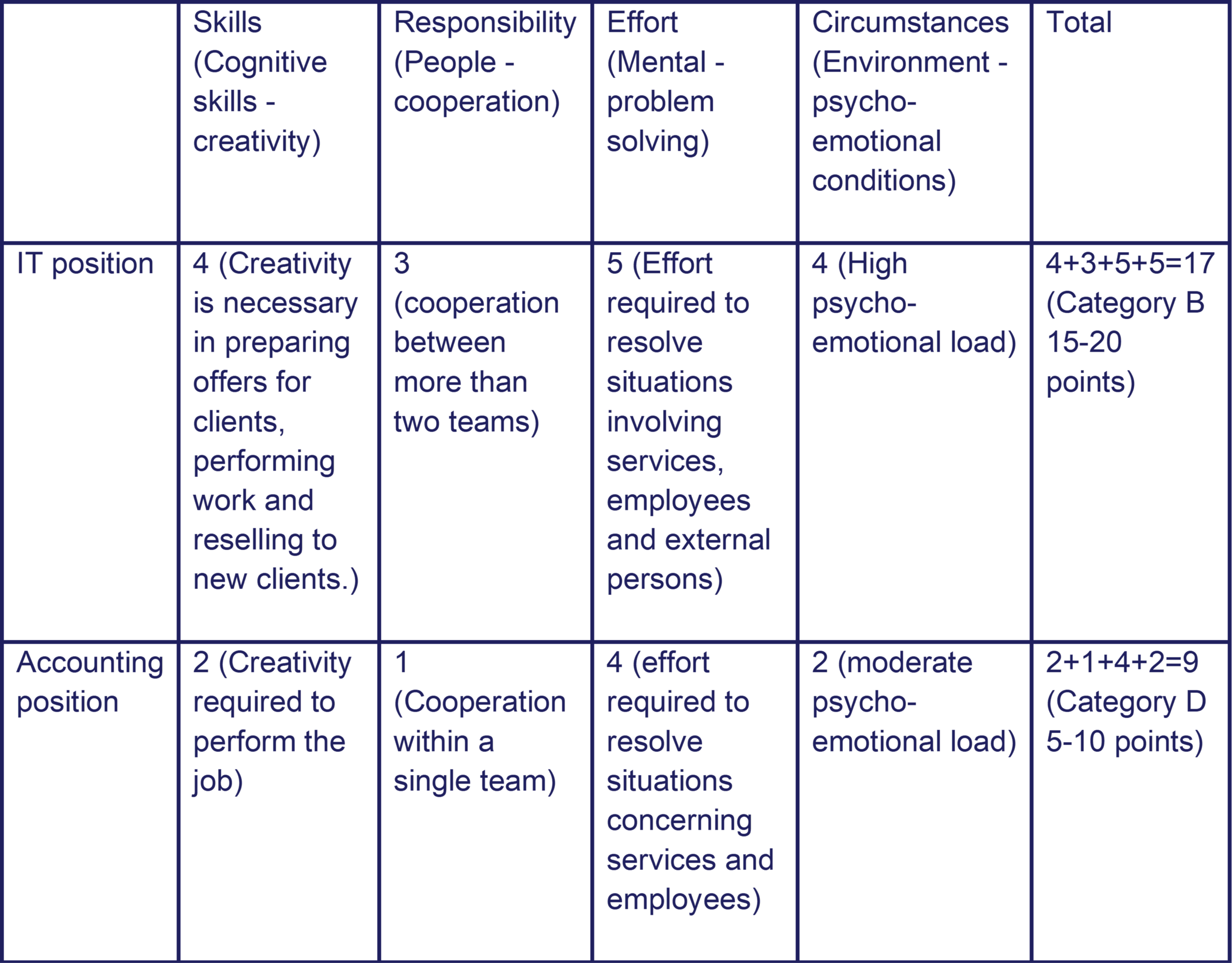
Thus, although competence (higher education, experience) may appear to be similar, the value of the work is different. Thus, the employer may set a lower salary for an accounting position. Qualitative, objectively applied criteria allow differences in pay to be justified based on the specific nature of each company’s economic activity.
How many criteria should be set?
The employer determines the sub-criteria at their discretion, unless the Latvian regulatory framework specifies a more detailed number of criteria (which is not expected at present). The required number is not specified, but too few criteria will not allow for the differentiation of different job values, while too many sub-criteria may result in a complex and practically difficult to apply value distribution.
The International Labour Organisation has indicated that 10-16 sub-factors are usually defined, depending on the size of the company and the diversity of positions. Their selection and interpretation may vary depending on the sector of activity.
Levels must also be set for each sub-factor. Four to six levels is the optimal number, but if the sub-factor is of secondary importance, there may be two or three levels, especially in smaller companies.
What remuneration will be taken into account in the equal pay assessment: basic salary or total remuneration received?
All total remuneration is taken into account for the assessment of pay. The Directive stipulates that the salary must be taken into account, as well as any other remuneration from the employer (e.g. bonuses, overtime pay, housing and food allowances, training allowances, severance pay, sick pay, etc.).
How should bonuses and premiums be assessed in the context of the Directive? Will employers have to grant all employees the same variable remuneration in future?
Bonuses, allowances and other variable remuneration must be taken into account in the assessment of pay. Employers should be able to justify differences in both basic pay and variable remuneration. With regard to variable remuneration, it is important that it is awarded on the basis of objective, transparent and uniformly applied criteria.
For example, an employer informs Employee A (male) that the pay level for his job category is 12,000-16,800 (1,000-1,400 EUR per month) and the average pay for men is 14,520 (1,210 EUR per month), while for women it is 15,180 (1,265 euros per month), but Employee A receives 13,200 (1,100 euros per month).
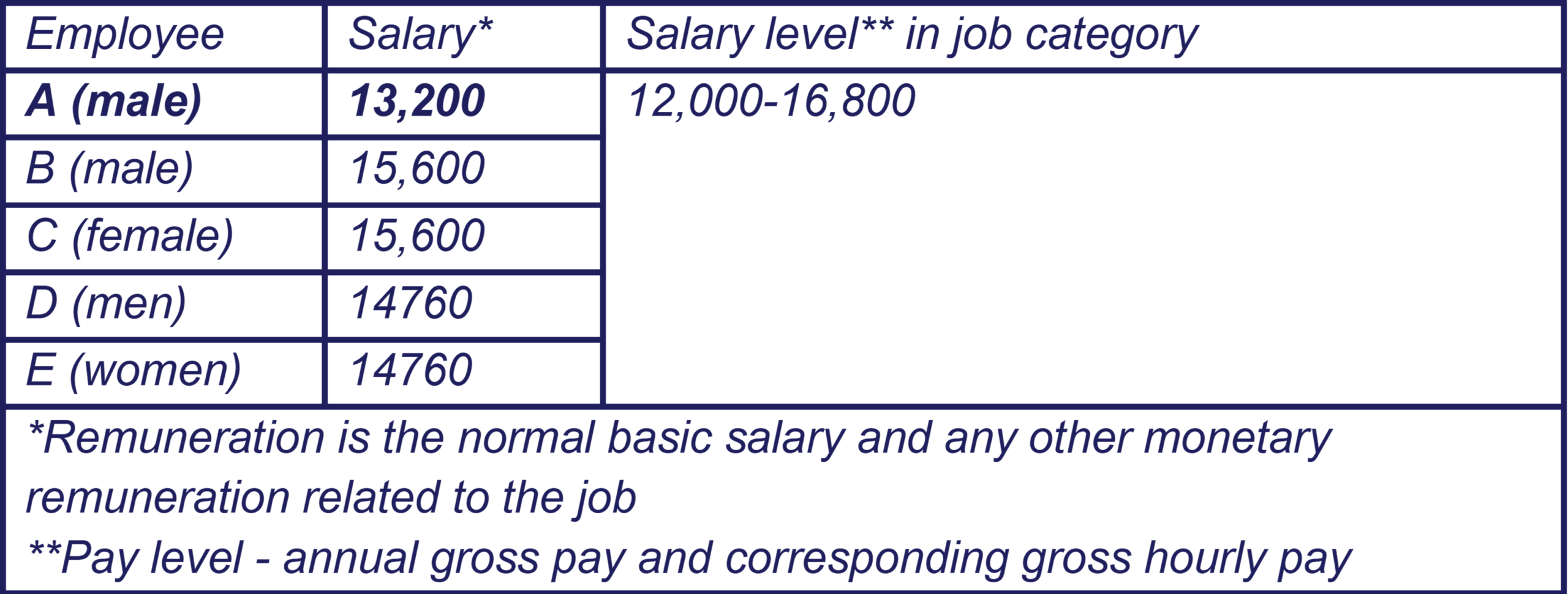
In this case, Employee A could approach the employer and ask for an explanation of why there is such a difference in average pay. If the employer cannot explain the difference, then it is possible that Employee A could take action against the employer with a claim for equal pay and request compensation.
There may be situations where Employees B and C (with whom Employee A has compared himself) have a higher average pay because these employees have received a higher annual bonus for better performance.
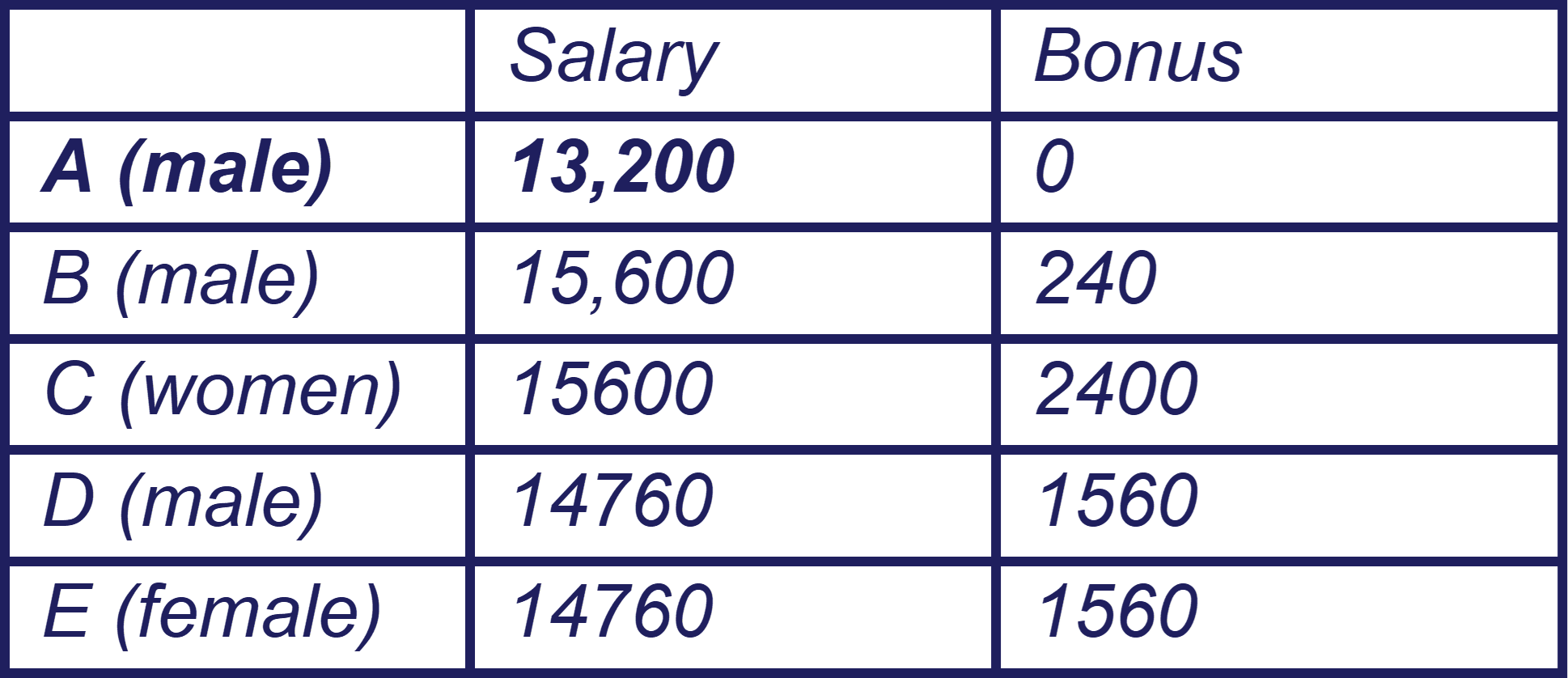
It is important that not only the criteria for determining the basic salary are objective and fair, but also the criteria for awarding the variable part of the remuneration. Therefore, employers should introduce transparent and fair bonus schemes (policies) that give employees in the relevant categories equal rights and opportunities to earn bonuses. Bonus policies are also linked to employee performance appraisals, so this procedure must also be objective and fair.
If such a system is introduced, employers will have no problem justifying pay differences, as they will be able to point to objective reasons for the differences. In the example above, the employee’s performance did not qualify them for a bonus, thus resulting in such a pay difference.
Of course, in reality, situations may not be so simple, especially since the assessment of pay must take into account all components of pay that the employer pays to the employee, but the above principles can be applied regardless of the complexity of the case.
What are the penalties for non-compliance with the obligations set out in the Directive?
The Directive does not specify a particular type of penalty, but mentions fines and restrictions on public procurement contracts. Interestingly, recital 55 of the Directive states that fines could also be calculated on the basis of the employer’s annual turnover, which would make the mechanism for infringements of the Directive comparable to the strict penalties of the General Data Protection Regulation. So far, however, countries have not introduced such a penalty system. For example, Poland has recently stipulated that the penalty for a violation could be up to EUR 11875.
It should also be remembered that if an equal pay violation is identified, adverse consequences may arise not only from the authorities but also from employees. In the event of a violation, the employee has the right to request compensation that ensures the restoration of their position to the situation they would have been in if the violation had not occurred.